
El Molinón: Spain’s Oldest Football Ground and the City That Never Left It
FBTG | Stadium Stories | Episode 03
By Kiril Yurukov · · Updated · 6 min read
Abstract
Long before the Santiago Bernabéu became a global football landmark and Camp Nou emerged as one of Europe’s most recognisable stadiums, football was already being played on a modest field beside a river in the northern Spanish city of Gijón.
There were no enormous stands, international broadcasting contracts or commercial entertainment facilities, only an emerging sport finding its place within a community shaped by industry, maritime trade and a growing enthusiasm for football.
That ground would become El Molinón, widely recognised as Spain’s oldest professional football ground still in use, and a venue whose history offers a fascinating perspective on how football developed from a local pastime into an international industry.
For more than a century, it has remained closely connected to Real Sporting de Gijón, a club whose identity is inseparable from the city and the generations of supporters who have followed it.
A football ground older than modern Spanish Football
The earliest documented evidence of football being played at El Molinón dates to 20 May 1908, when the local newspaper El Comercio reported a match between La Bella Sportiva and El Balón.
The report was brief, but its historical importance is considerable, establishing that the ground was already being used for football at a time when the sport was still developing across Spain.
The precise date of the ground’s original construction remains unknown, which makes 1908 the earliest confirmed reference rather than a definitively established opening date.
Even its name reflects the area’s industrial past, originating from a large watermill that once stood nearby, powered by a tributary of the Piles River.
Sporting de Gijón, founded in 1905, began using the ground during the following decade, and by 1917 El Molinón had undergone improvements that helped establish it as a permanent football venue.
What began as a relatively simple playing field was gradually transformed into the centre of Gijón’s sporting identity.
A stadium that witnessed Spanish Football growing up
As Spanish football developed more formal competitions and attracted larger audiences, El Molinón became an increasingly important venue.
In 1920, it hosted the Copa del Rey final between Barcelona and Athletic Club, bringing two of the country’s leading teams to Asturias at a time when the national football landscape was still taking shape.
Eight years later, on 22 April 1928, the Spanish national team played Italy at El Molinón, with the match ending in a 1-1 draw.
These occasions demonstrated that Gijón’s stadium was more than the home of a regional club, becoming a venue capable of hosting some of Spanish football’s most significant fixtures.
The ground continued to evolve through successive expansions and reconstruction projects, reflecting the increasing popularity of the sport and the changing expectations of spectators.
Yet its history was not without setbacks.
In 1931, a fire destroyed the main grandstand, creating a substantial financial burden for Sporting and contributing to the difficulties surrounding the stadium’s future.
The club had acquired the ground in 1924, but financial pressures eventually led to municipal ownership, establishing a relationship between the stadium and the city that continues today.
The World Cup and one of football’s most infamous matches
El Molinón entered international football history during the 1982 World Cup, when Spain hosted the tournament and Gijón was selected as one of its venues.
The stadium staged three group-stage matches, including the encounter between West Germany and Austria on 25 June 1982, a game that would become notorious as the Disgrace of Gijón.

West Germany took an early lead through Horst Hrubesch, and with a 1-0 result sufficient to send both European teams through at Algeria’s expense, the remainder of the match was characterised by a striking lack of attacking urgency.
Although no formal agreement between the teams was established, the spectacle provoked widespread criticism and became one of the most controversial episodes in World Cup history.
Its consequences extended beyond Gijón, contributing to FIFA’s subsequent decision to schedule the final matches of World Cup groups simultaneously, reducing opportunities for teams to benefit from knowing another result in advance.
For a stadium that had spent decades hosting domestic football, the controversy created an unexpected place in the history of international tournament governance.
It remains a remarkable example of how events inside a stadium can influence the rules and organisation of the sport far beyond its own city.
The home of Quini and a City’s Football identity
While the World Cup gave El Molinón international recognition, its deeper significance has always been connected to Sporting de Gijón and the supporters who regard the stadium as part of their city’s identity.
Few figures represent that relationship more powerfully than Enrique Castro González, universally known as Quini, one of the most celebrated strikers in Spanish football history.

Quini became a defining figure at Sporting before enjoying further success with Barcelona, and his extraordinary connection to the Asturian club remained central to his legacy.
Following his death in 2018, the stadium’s official name was expanded to Estadio El Molinón–Enrique Castro Quini, honouring a footballer whose career symbolised the relationship between local identity and sporting achievement.
Unlike the enormous global brands associated with Spain’s biggest clubs, Sporting’s relationship with El Molinón has been built around a more intimate form of loyalty, where the stadium represents continuity through promotion campaigns, relegations, financial challenges and changing generations.
That connection is particularly important in a city whose economic and cultural development has long been associated with the industrial and maritime traditions of northern Spain.
History meets modern football economics
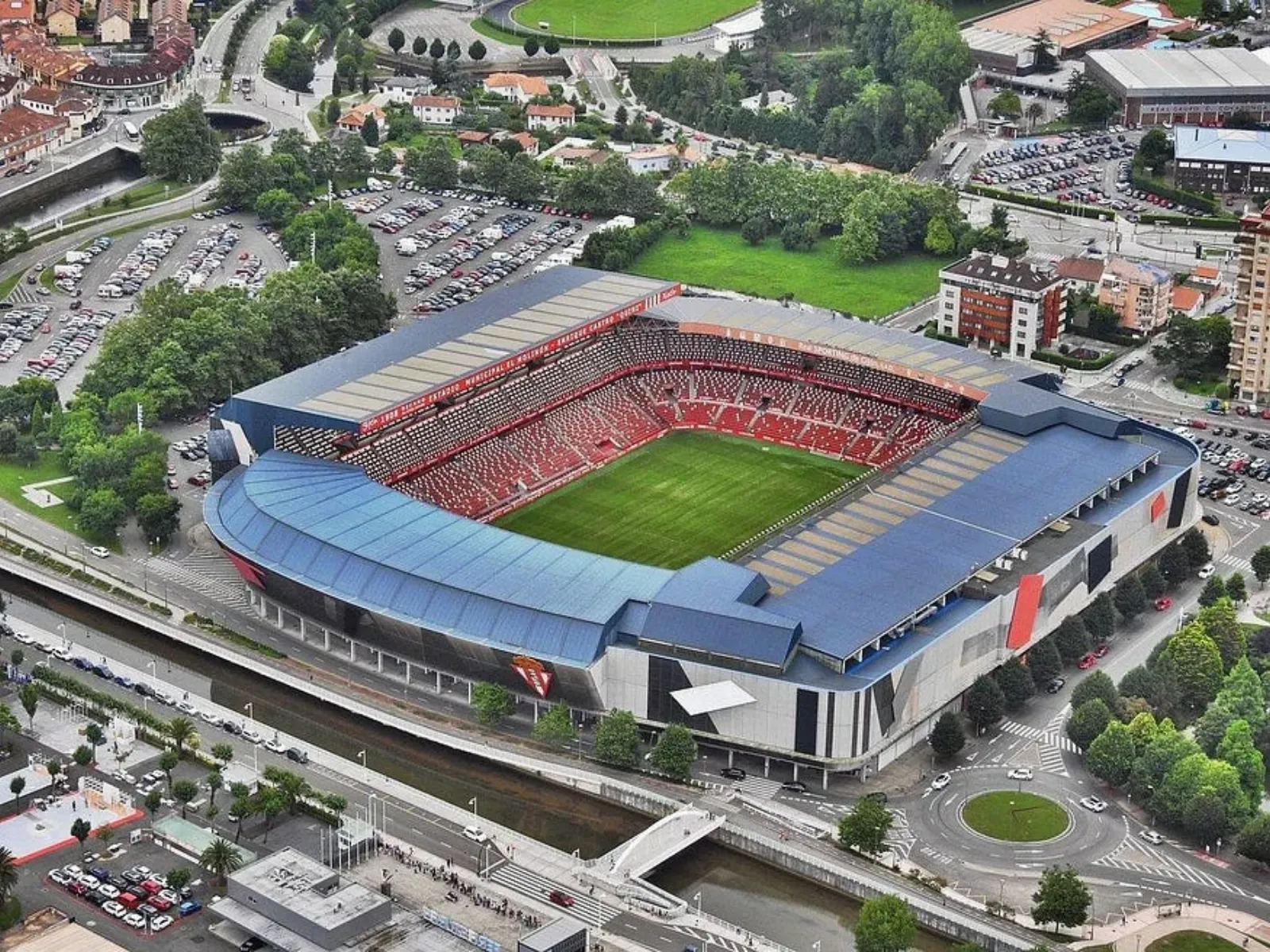
Today, El Molinón accommodates approximately 29,370 spectators, a considerably smaller capacity than many of the stadiums associated with Europe’s most commercially powerful clubs.
Its limitations reflect a challenge faced by historic football grounds throughout the continent, how to improve facilities, increase revenue and meet modern expectations without losing the identity that makes them valuable.
Successive renovations have changed the stadium’s appearance, including significant modernisation during the years surrounding 2010, but its location and historical significance remain central to discussions about its future.
For Sporting, stadium development is not simply a question of increasing ticket sales, because modern football venues are increasingly expected to generate income through hospitality, commercial partnerships, events and activities beyond matchdays.
The challenge is to pursue those opportunities while respecting a ground that has occupied the same place in the city’s football culture for more than a century.
For smaller clubs, that balance can be particularly difficult, as major infrastructure investment carries financial risks that must be measured against realistic revenue opportunities.
More than a century in the same place
The story of El Molinón is not built around countless European trophies, billionaire ownership or the global commercial influence of Spain’s largest clubs.
Its importance comes from something more fundamental, the stadium has witnessed the development of Spanish football almost from its beginnings, while remaining closely connected to the community that gave it life.
From a newspaper report in 1908 to international matches, the 1982 World Cup and the modern challenges of stadium redevelopment, El Molinón has been part of football’s evolution across dramatically different eras.
Its history also shows that a stadium’s significance cannot be measured exclusively through the success of its resident club, the number of seats it contains or the commercial income it generates.
Some grounds become famous because of the trophies won inside them. Others matter because they have been there throughout the game’s transformation.
El Molinón belongs to the second category.
And after more than 118 years of documented football history, Spain’s oldest professional football ground remains a reminder that the game’s most valuable heritage is not always found in its biggest stadiums.
Related Stories
Estadio Centenario: The Stadium Where the World Cup Was Born
On 30 July 1930, thousands of spectators gathered inside a newly constructed stadium in Montevideo to witness an event that would eventually become one of the most important occasions in international sport. Uruguay faced Argentina in the final of the first FIFA World Cup, with the hosts recovering from a half-time deficit to win 4-2 and become football’s inaugural world champions.
· 8 min read
Stadio Luigi Ferraris: 115 Years, Two Rivals and One Football City
In modern football, stadiums are increasingly designed to maximise commercial revenue, attract international visitors and provide clubs with a competitive financial advantage. Yet in the heart of Genoa, surrounded by apartment buildings and the narrow streets of the Marassi district, stands a stadium whose identity has been shaped by something far more complicated than business.
· 5 min read
Turf Moor: 143 Years of Football, History and Working-Class Identity
In an era when football clubs are investing hundreds of millions in futuristic stadiums, luxury hospitality and commercial entertainment complexes, one of English football’s most remarkable venues continues to stand in the heart of a former industrial town in Lancashire.
· 5 min read